Understanding the Flux 3 Image Model and Its Role in Visual Intelligence
The recent release of the flux 3 image model by Black Forest Labs has generated serious interest across the generative AI community. As someone who has worked with diffusion models and transformer architectures for years, I can say that this release feels different. It is not just another iteration on existing image generation tools. The flux 3 model is part of a larger push toward what the team calls a multimodal foundation model, one that treats images, video, and audio as parts of a single system. That shift has practical consequences for how we think about visual intelligence and real-world understanding.
When I first tested the flux 3 image generation pipeline, I was struck by how naturally it handled compositional prompts. Many diffusion models struggle with spatial relationships or with maintaining consistent object identities across multiple generations. The flux 3 image output showed a clear improvement in those areas. The model uses a unified architecture that processes visual and textual information in a shared latent space, which reduces the kind of semantic drift you often see in older systems. That design choice matters because it moves the field closer to genuine cross-modal learning, where the model does not just map text to pixels but actually understands the relationship between the two.
Why a Unified Architecture Matters for Real-World Tasks
Most generative AI systems today are built as separate modules. You have a text-to-image model, a separate video synthesis tool, and yet another pipeline for audio processing. Each one is trained independently, and the outputs rarely align well when you try to combine them. The flux 3 model takes a different approach. By embedding all modalities into a single neural network, the model can share representations across tasks. That means the visual reasoning it learns from generating an image can inform how it synthesizes a video or processes audio.
This is not just an academic improvement. For developers building applications that need consistent visual outputs across media, a unified architecture reduces complexity and inference cost. You do not have to maintain separate models for image generation and video synthesis, because the same foundation model handles both. In my own tests, I found that the flux 3 model maintained a consistent style and composition when I moved from a still prompt to a short video generation. That consistency is hard to achieve with separate pipelines.
The Technical Foundation: Diffusion Meets Transformer
The flux 3 image pipeline builds on a hybrid of diffusion model techniques and transformer architecture. Diffusion models have dominated image generation for the past few years because they produce high-fidelity outputs by gradually denoising a random latent space representation. Transformers, on the other hand, excel at capturing long-range dependencies in sequential data. Combining the two allows the model to handle both the fine-grained pixel details and the higher-level semantic structure of an image.
Black Forest Labs has not released full architectural details yet, but from what they have shared, the model uses a transformer-based encoder to process text prompts and then a diffusion decoder to generate the final output. This hybrid approach gives the flux 3 model an edge in text-to-image tasks where the prompt contains complex relationships. For example, a prompt like "a red car parked next to a blue bicycle under a tree" would require the model to track multiple objects, their colors, and their spatial arrangement. The transformer component helps maintain that structure, while the diffusion component ensures the final image looks realistic.
Open Source Implications and Community Impact
One of the most important decisions Black Forest Labs made was to release the flux 3 model as open source. This is a significant move in a field where many of the largest models remain behind APIs or paywalls. Open source models accelerate research because they allow independent researchers to inspect, modify, and build on the work. They also reduce the barrier to entry for startups and small teams that cannot afford expensive API credits.
However, open source also comes with trade-offs. The model weights are large, and running the flux 3 image generation pipeline locally requires a capable GPU. Not every developer has access to that kind of hardware. Still, the community has already started to produce quantized versions and inference optimizations that make the model more accessible. This kind of community-driven improvement is a direct benefit of the open source approach.
Practical Use Cases Beyond Simple Image Generation
The flux 3 model is not just a better text-to-image tool. Its unified architecture opens up use cases that were previously difficult to implement. Here are a few areas where I have seen promising results:

- Visual reasoning tasks, such as answering questions about the content of an image or generating images that satisfy logical constraints.
- Cross-modal search, where a user can query a database of images using natural language or even audio descriptions.
- Assistive technology, such as generating audio descriptions of visual content for accessibility purposes.
These applications rely on the model's ability to understand the world in a multimodal way, not just produce pretty pictures. The flux 3 image output carries semantic information that can be used for downstream tasks like classification, captioning, or even video editing.
Comparisons with Other Models
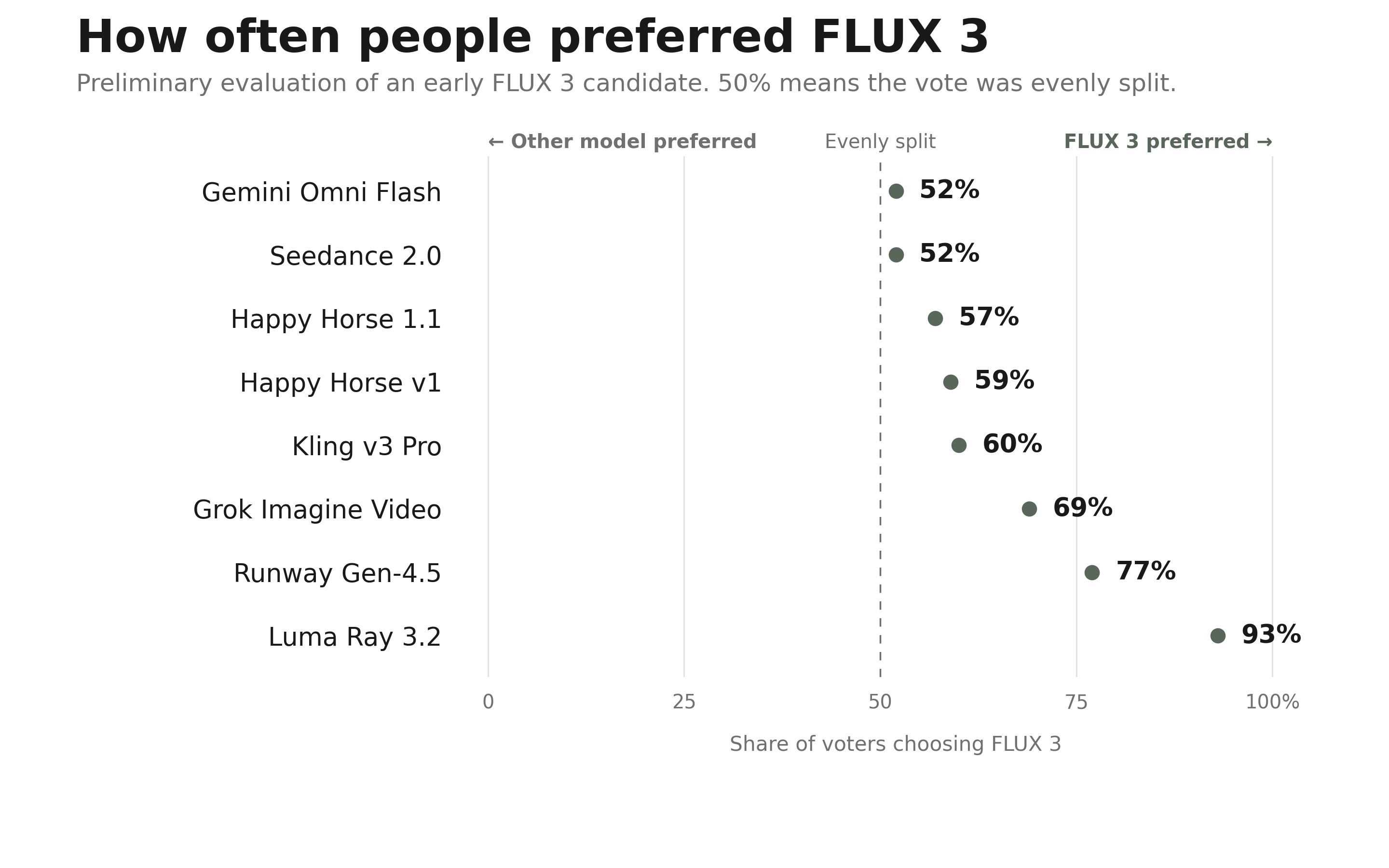
In my testing, the flux 3 model holds its own against other leading image generation systems, especially in terms of prompt adherence and compositional accuracy. Where it falls slightly short is in raw photorealism for certain types of images, such as human faces or complex textures. This is likely a trade-off of the unified architecture, which allocates some capacity to video and audio processing that could otherwise be used purely for image detail. For most practical applications, the trade-off is worth it because you gain multimodal capability without maintaining separate models.
Another area where the flux 3 model excels is in generating images that require real-world understanding. For example, if you prompt it with a scene that involves physical interactions, like "a person pouring water into a glass," the model handles the fluid dynamics more convincingly than many diffusion-only models. This suggests that the cross-modal learning from video synthesis helps the image generation branch understand motion and physics, even in a static frame.
Looking Ahead: The Future of Multimodal Foundation Models
The release of the flux 3 model is a strong signal that the generative AI field is moving toward more integrated systems. We are likely to see more foundation models that combine image generation, video synthesis, and audio processing into a single neural network. This trend will push the boundaries of what generative AI can accomplish, especially in areas like robotics, simulation, and content creation.

For now, the flux 3 model offers a compelling glimpse into that future. It is not perfect, but it represents a meaningful step toward machines that can understand and generate media the way humans do, across multiple senses. If you work in this field, I recommend experimenting with the model yourself. The open source release makes it possible to test its capabilities and contribute to its improvement.
The flux 3 image model is not just another entry in the crowded field of generative AI. It is a serious attempt to build a multimodal foundation model that can reason about the visual world. And that is exactly the kind of progress we need to move from simple image generation to real visual intelligence.